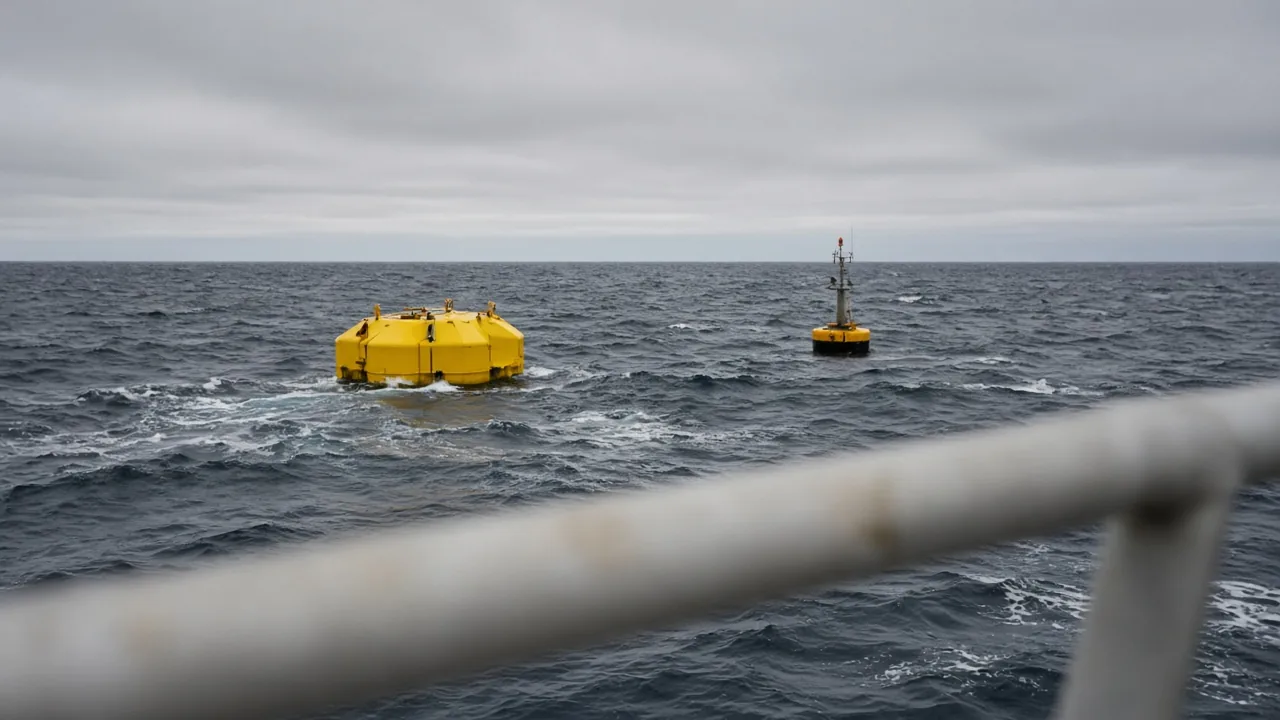
Apply one tidal study to every machine and the environmental conclusion fails. A barrage that holds an estuary, a turbine in a channel, a construction closure, and a small operating group are different records.
The public pages opened for this article do not share one environmental result. Ascher, Gray and Collins included 54 empirical papers in their 2025 review in Ecological Solutions and Evidence. Thirty of those papers are on tidal range and 24 are on tidal stream, and Table 2 records positive, neutral and negative effects in different cells. Imperial College London’s news report on that study, dated 15 October 2025, says fears about tidal-flow machines harming animals are generally unfounded. The Ocean Energy Systems chapter abstract of 17 September 2024 says collision risk around turbines still needs more data before it can be retired, and it limits several other retirements to small numbers of devices. This page lines those statements up. It does not clear a project.
Ocean Energy Notes compiled the matrix from those documents. How a tidal stream differs from a tidal range, including slack water, is already set out in wave energy versus tidal energy.
Key points
- Read the machine first. A barrage holds water. A stream turbine sits in the current and, in the 2025 review’s wording, does not make a solid barrier across the flow.
- Table 2 of that review mixes positive, neutral and negative cells. “No evidence of effect” is the review’s label for an empty cell, and this page leaves it as that label.
- The 17 September 2024 OES abstract retires operational noise, cable electromagnetic fields, habitat change from a small footprint, and oceanographic change for small numbers of devices. It does not retire collision.
- The April 2011 NOAA workshop memo separates a measurable effect from an impact that rises to deleterious ecological significance. It records a March 2010 meeting on turbines in the water column.
- Wolf, Walkington, Holt and Burrows (2009) write about estuarine barrages. Their abstract names intertidal area retained after construction as the largest environmental impact they expect.
Which machine is the sentence about?
Name the machine before you reuse the sentence. In the 2025 review, a tidal-range plant holds water behind a barrier. A tidal-stream plant uses the kinetic energy of the current. Turbines in that second group are anchored, floating or hung in the water column, and the review says horizontal-axis turbines are the most common of the forms it lists. The same section says stream machines do not create a solid barrier to the flow, which is why the review expects fewer ecosystem-wide effects than from a barrage, and why more than 80% of the stream papers it kept are about vertebrate animals and the turbines.
Gray-green water runs between two rocky shores under a flat cloud deck. No machine is in the frame.
The review describes typical stream sites as narrow straits and shallow channels where the coast speeds the water. The photograph is a generic coast.
The papers behind the barrage half of the review are uneven. Of the 30 tidal-range papers, 17 are about La Rance, 5 about Sihwa Lake, 4 about Annapolis Royal and 4 about Kislaya Guba. The review found no relevant ecological articles for the Jiangxia plant. Stream papers cluster too: 8 from Scotland, 4 from Strangford Lough, 4 using more than one UK site, 2 from Fundy, 1 from Puget Sound, 3 from Japan and 1 from Tasmania. A finding from one of those clusters does not automatically travel to the next.
What did the 2025 review put in the table?
The authors kept empirical papers only. They set models and selective reviews aside, searched without a date cutoff, and looked for Chinese, French, Korean and Russian work as well as English. From 579 titles, 54 papers remained: 45 in English, 6 in French, 2 in Korean and 1 in Russian. Table 2 is their summary of effects those papers reported. A cell can hold more than one direction.
| Ecological risk | Tidal range, as Table 2 states it | Tidal stream, as Table 2 states it |
|---|---|---|
| Turbine and animal interaction | Neutral at La Rance for passage through sluices and turbines, and at Kislaya Guba for most fish. Negative at Annapolis Royal, where experiments reported high fish mortality, almost half, and one species entirely eradicated. At La Rance, silver eels’ migration was disrupted, which the table links to noise and tidal disturbance from the barrage. | Neutral. Harbour porpoises and seals showed local avoidance that was not found to change overall population distribution. Fish studies indicated low collision risk and reported no injuries. The turbine did not stop animals crossing the channel. |
| Underwater noise | No evidence of effect | Neutral for hearing and for behaviour beyond the immediate area, with emissions below ambient levels at busy port sites. Negative where turbine noise and pile driving reduced local seal foraging, and where devices limited listening space for some marine mammals. |
| Hydrodynamics | Positive for lower storm surge and coastal flooding risk inside the basin. Neutral where currents in the impoundment fall while flows are amplified at sluices and turbines. Negative for a smaller tidal range, less exchange with the sea, an artificial tide, longer slack water, a higher mean water level and weaker drainage. | No evidence of effect |
| Sediment | Positive at Sihwa Lake for sedimentary organic matter after anoxic conditions. Neutral for redistribution tied to drainage, turbine currents and longer slack water. Negative for shoreline erosion at Annapolis Royal, sandbank and riverbed change at La Rance, and a residual sediment flux into Sihwa Lake. | Negative at some less suitable sites, where loss of fine sediment binding raises erosion risk. |
| Water quality | Positive for two-way operation at La Rance (less stratification, lower turbidity, more circulation) and for seawater exchange at Sihwa Lake. Neutral where quality stayed consistent while the salt front moved upstream in summer at La Rance. | No evidence of effect |
| Habitat | Positive where a smaller tidal amplitude and less storminess increased richness and stability on sandbanks and mudflats. Neutral for redistribution of those banks. Negative where a higher low-water level submerges part of the intertidal zone, and where some ground stays underwater. | Positive where anchors add benthic substrate. Negative where local seal avoidance beside turbines is read as habitat loss. |
| Species and community | Positive for higher benthic biomass, diversity and density, high plankton and mudflat invertebrate production at La Rance, more fish species than nearby estuaries, and a basin designated for waterbirds. Neutral for a changed fish community at La Rance that stayed fairly stable over the long term, and for a new benthic community at Kislaya Guba that took 16 years of steady operation to settle. | Positive where the structure gathered fish and, with them, more seabirds. |
The collision subsection adds conditions the summary row compresses. At Annapolis Royal, tagged-fish studies showed high mortality from turbine passage, and the review says high mortality of sturgeon longer than 1 m may partly come from the STRAFLO turbine used there, a machine chosen for an operational trial and different from a conventional bulb turbine. At Kislaya Guba, the cited work found that 99% of fish smaller than 25 cm passed through the turbine. At La Rance, a recent silver-eel study reported impedance, while earlier studies described normal migratory behaviour and free passage, with no ecological disruption relative to nearby sites. The review also says gas-bubble disease, discussed for river hydropower, has not been evidenced at these tidal plants, which have much lower drops and pressures. It notes a lack of fish-impact literature at Sihwa Lake and ties that gap to earlier pollution in the basin.
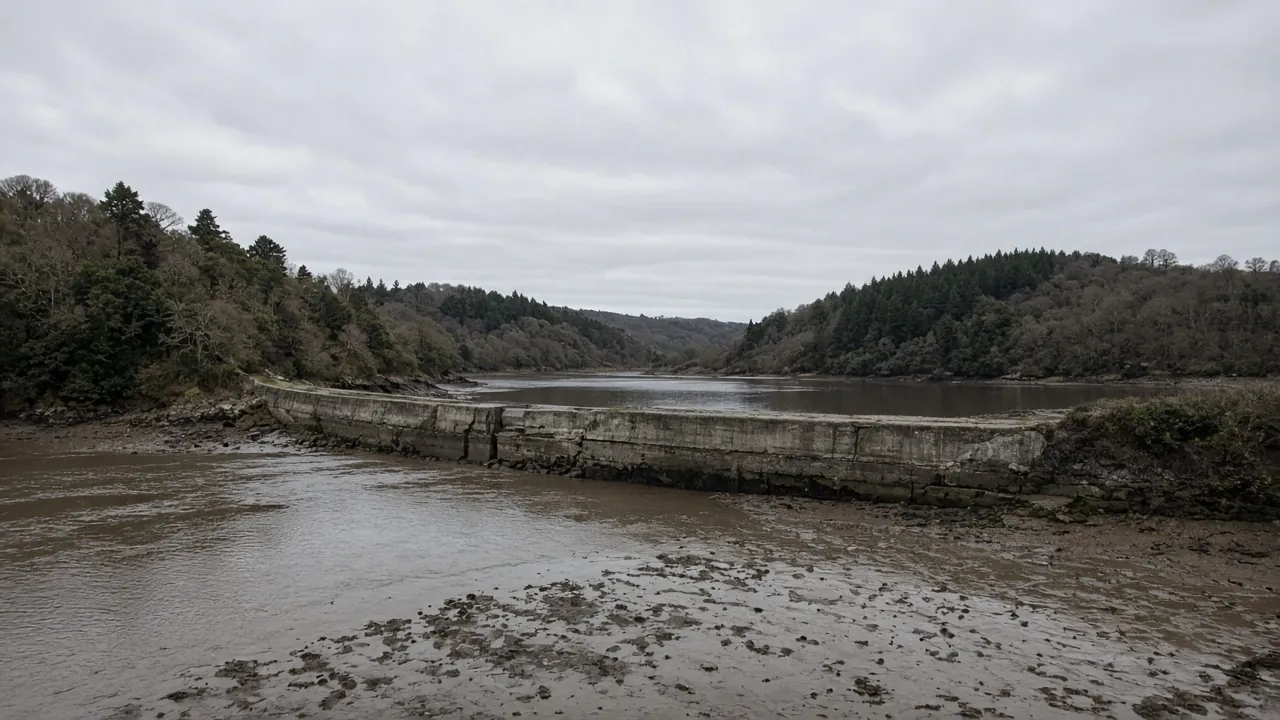
A cracked concrete wall runs from one wooded bank to the other. Brown water and mud fill the foreground, and a quieter basin sits behind the wall.
The photograph is a generic estuary wall. The plants named above are the ones in the review.
Where does the October 2025 news line sit?
Imperial’s news report, dated 15 October 2025, calls the same study the most comprehensive review to date and says it covered more than 50 papers from Europe, Asia and North America. The paper’s own count, in the section above, is 54. The news report says widespread fears of lasting ecological harm are not substantiated, and that many impacts seen from the 1960s to the 1980s were tied to construction that sealed estuaries off completely, with poor water quality, disrupted habitats and shifts in species composition. It says the waters inside the La Rance and Sihwa Lake barrages later held stable, richer ecosystems, with greater diversity and abundance and better water quality recorded. On stream machines, the report says concerns are generally unfounded: fish and marine mammals tend to avoid the turbines, and monitoring shows no evidence of population decline or habitat fragmentation.
Dr Tilly Collins is quoted there: changes do occur, most are manageable, and habitats behind barrages can become wildlife-rich. The same story says local changes in sediment, tidal range and species distribution are not uniformly negative.
Set that paragraph beside Table 2 and beside the OES abstract. Table 2 still has negative cells, including Annapolis fish mortality, La Rance silver eels, intertidal ground lost behind barrages, and, for stream machines, seal foraging and a habitat-loss reading of local avoidance. The OES abstract of 17 September 2024 says uncertainty about collision remains a barrier to consenting tidal and riverine projects, and that collision risk needs more data before it can be retired. The news wording and those two limits can be true of different rows. “Unfounded” in the news report is not a clearance for every plant, every phase or every array size.
Which stressors does the 2024 chapter retire?
Chapter 3 of the OES-Environmental 2024 State of the Science report, by Garavelli, Hemery, Rose, Farr, Whiting and Copping, is dated 17 September 2024. The abstract covers marine renewable energy, tidal included, and also wave devices and, in one section, ocean thermal energy conversion. The status words below are the abstract’s. Where it gives no device count and no decibel level, the cell is blank.
| Stressor in the abstract | Status the abstract gives | Scale the abstract states | Device count | Noise level |
|---|---|---|---|---|
| Collision with turbine blades | Not retired. More data and studies are needed. Few deployments and hard near-field measurements limit what is known. | Tidal and riverine turbines. Marine mammals may detect a turbine and avoid the rotor area once the current rises and the blades turn. | ||
| Underwater noise from turbines and wave converters | Retired for the conditions named. Operational noise is not likely to harm marine species. | Small numbers of devices, and small developments. | ||
| Electromagnetic fields from export cables and devices | Retired. Signatures at the power those cables carry are generally believed to sit below a significant risk level. | Small numbers of devices. Laboratory work used fields higher than export-cable fields. | ||
| Benthic and pelagic habitat change | Retired. A small footprint is not likely to cause significant harm if the site is chosen carefully. | Small numbers of devices: anchors, foundations, mooring lines, cables and surface floats. | ||
| Oceanographic change (wave height, circulation, water-column stability) | Retired for small numbers. Field checks have not separated device effects from natural variability. Until large arrays exist, the abstract says numerical models are the main view of the risk. | Small numbers of devices. Large arrays are outside that retirement. | ||
| Entanglement in mooring lines and cables | No evidence to date that it will occur. For small numbers it should be considered not significant. The abstract still calls the risk theoretical. | Small numbers of devices. Larger arrays are left open. | ||
| Displacement of animals | Low at this time. Models depend on place and population. Little data will exist until larger arrays are deployed. | Current deployments. Larger arrays are the open case. |
Two animal notes in the collision section are easy to mis-file. Adult salmon in a river were not likely to be close enough to rotating riverine blades to collide. Salmon smolts were more likely to pass through the rotor and become disoriented, and longer-lasting harm was not shown. Diving seabirds had not been observed near rotating turbines, though they gather where turbines might be installed. Those sentences are about the animals and settings the abstract names. They are not a barrage result, and they are not a species count.
What did the 2011 NOAA workshop define?
The NOAA technical memorandum F/SPO-116, published in April 2011, reports a workshop held in Seattle from 22 to 25 March 2010. The editors, Polagye, Van Cleve, Copping and Kirkendall, separate two words. An environmental effect is a measurable interaction between tidal devices and the marine environment. An environmental impact is an effect that, with high certainty, reaches deleterious ecological significance. The workshop aimed at an initial assessment of installation, operation, decommissioning and maintenance for turbines placed in the water column in the United States. It did not take up policy, engineering detail or socio-economic impacts. The summary says critical knowledge gaps hinder evaluation of environmental impacts.
On installation time, the technology section says a single device on a gravity foundation may take a few hours, and a large array on piled foundations may take longer than a year. That is a duration range for putting machines in, not a measured ecological effect.
On energy removal, a later section says participants agreed it could affect each receptor, and that this agreement comes with a high degree of uncertainty. The same passage says energy removal may result in measurable changes to tides, currents and mixing across a region, with effects on water quality, habitat and biological productivity. “May” and the uncertainty clause are part of the claim. The memo is a 2010 workshop record. It is not a substitute for the 2024 or 2025 pages above.
What did the 2009 barrage paper expect?
Wolf, Walkington, Holt and Burrows (2009) describe possible environmental changes from tidal power, illustrated with schemes in the eastern Irish Sea, and they focus on major estuarine barrages. They use a 0-D model for a wide set of options and a 2-D depth-averaged model (ADCIRC) of the west coast of the UK with and without barrages, with grid spacing down to 50 m around the barrage sites. The body applies that work to the combined effect of five barrages on estuaries in northwest England and Wales. The abstract says the models show there may be a significant change in tidal amplitude on the coast of Northern Ireland, that bed stress in the Bristol Channel will be significantly reduced if a Severn barrage is built, and that some change in tidal mixing is expected while the position of tidal fronts in the Irish and Celtic Seas will not change significantly. The abstract does not print those changes in metres or in a stress unit. This page does not add the missing units.
The largest environmental impact they expect is the intertidal area still exposed after an estuarine barrage. They write that the loss of mudflats can be cut substantially by a dual-mode scheme, generating on both ebb and flood, with more turbines than the lowest-cost option. Impacts, they say, may be beneficial as well as harmful, and some mitigation is possible. For La Rance they cite increased muddiness of the seabed and higher productivity of the foreshore as illustrations, from Kirby and Retière (2007).
Local physical changes in their section 2.1 follow from holding water for part of the tide: altered tidal and residual flows, possible scour near turbines and sluices, siltation in the basin, less vertical mixing, clearer water, stronger stratification, fresher water inside the basin, and a possible build-up of contaminants where flushing drops. They say these effects depend to a large degree on how the barrage is operated, and that they are specific to the site. The most publicised ecological impact in their section 2.2 is loss of intertidal mudflats and salt-marshes. Migratory fish may be blocked, and fish passes can be built. Fish and marine mammals may be hurt by collision with the barrage and the turbines. Those sentences are expectations and review points for barrages, tied to the models and the literature they cite. They are not a stream-turbine monitoring result.
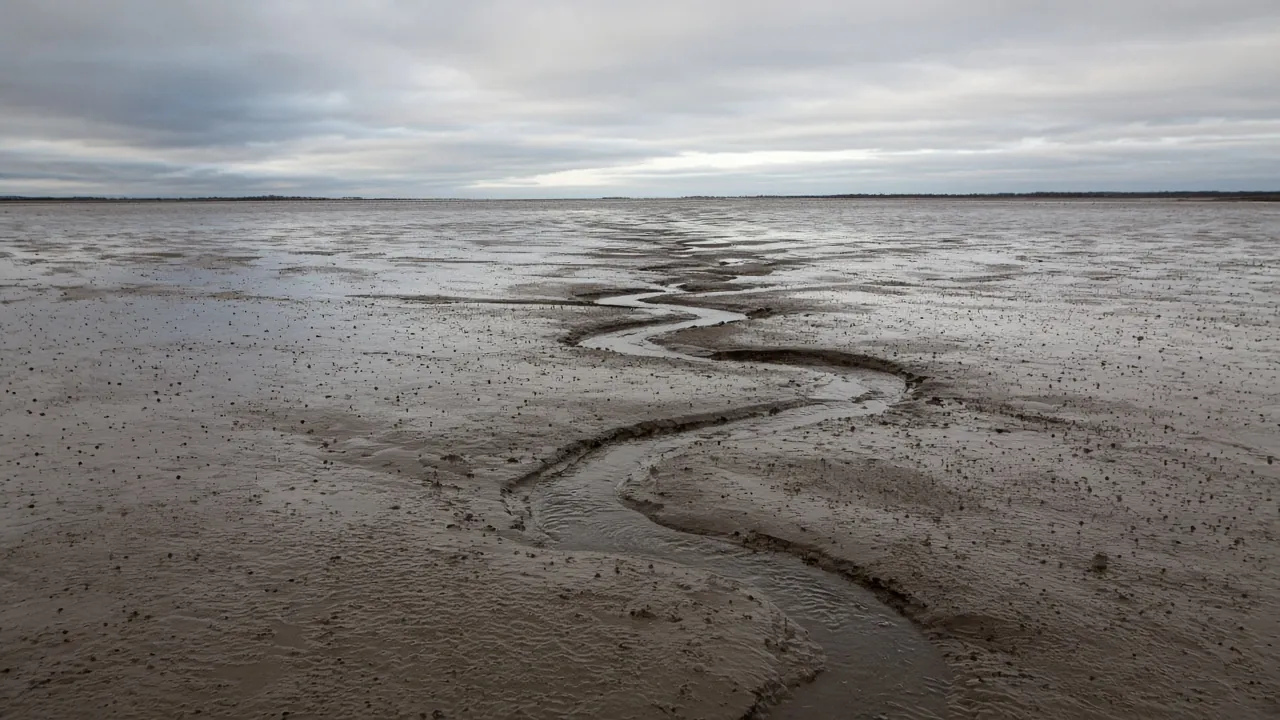
A wide mudflat at low water, with a shallow channel winding through wet mud under cloud.
Exposed mud is the habitat the 2009 paper treats as the main barrage question, and the habitat Table 2 says can shrink when the low-water level rises. The photograph shows that ground. It is a generic flat, not a survey of a named estuary.
When this reading does not apply
Use a different document when the question is not “which row does this evidence sit in?”
- A permit, a site approval, or a finding that a named project is harmless. Nothing here is an environmental impact assessment. The 2025 news line does not retire the negative cells in Table 2, and the 2024 abstract does not retire collision.
- A decibel level, a full species list, or a device count for “small numbers.” The OES abstract leaves those cells empty, and this page leaves them empty.
- An efficiency percentage. Conversion efficiency, power coefficient and capacity factor use different denominators, which how efficient tidal power is separates. This page does not add a ratio.
- A wave-energy project. Wave devices are inside the OES chapter’s scope and outside the 2025 tidal review. The wave energy explainer is the page for how waves become electricity.
- The former user of this domain. Who publishes these notes is on the About page.
Methods and sources
Compiled on 14 October 2026 from the pages listed below, in the passages actually opened. For Ascher, Gray and Collins (2025, DOI 10.1002/2688-8319.70124) those passages are the plant descriptions, the methods, the literature counts, Table 2 and the collision subsection 3.2.1. The Imperial College London news report is the 15 October 2025 story on that paper. The OES text is the Tethys abstract of Chapter 3, Garavelli and colleagues, 17 September 2024, doi:10.2172/2438589. The NOAA text is Tech. Memo. F/SPO-116 (April 2011): the effects-versus-impacts definition, the workshop goals, the installation-duration sentence, and the energy-removal paragraph with its uncertainty clause. The 2009 paper is Wolf, Walkington, Holt and Burrows: the abstract, the modelling description, and sections 2.1 and the opening of 2.2. Claims that sit outside those passages are not used. No device was tested for this article. The photographs are generic scenes.
Full links are in the references below. Every explainer is listed on the articles page.