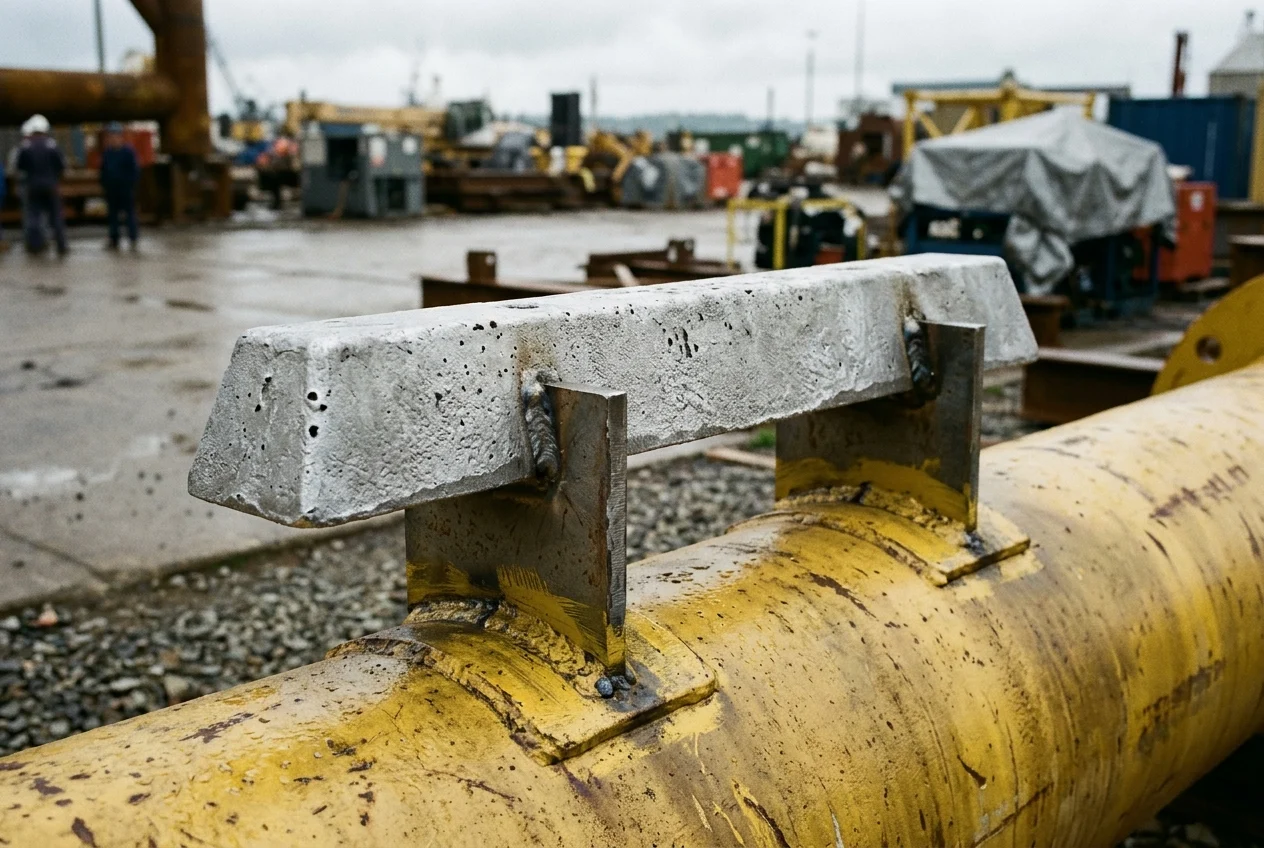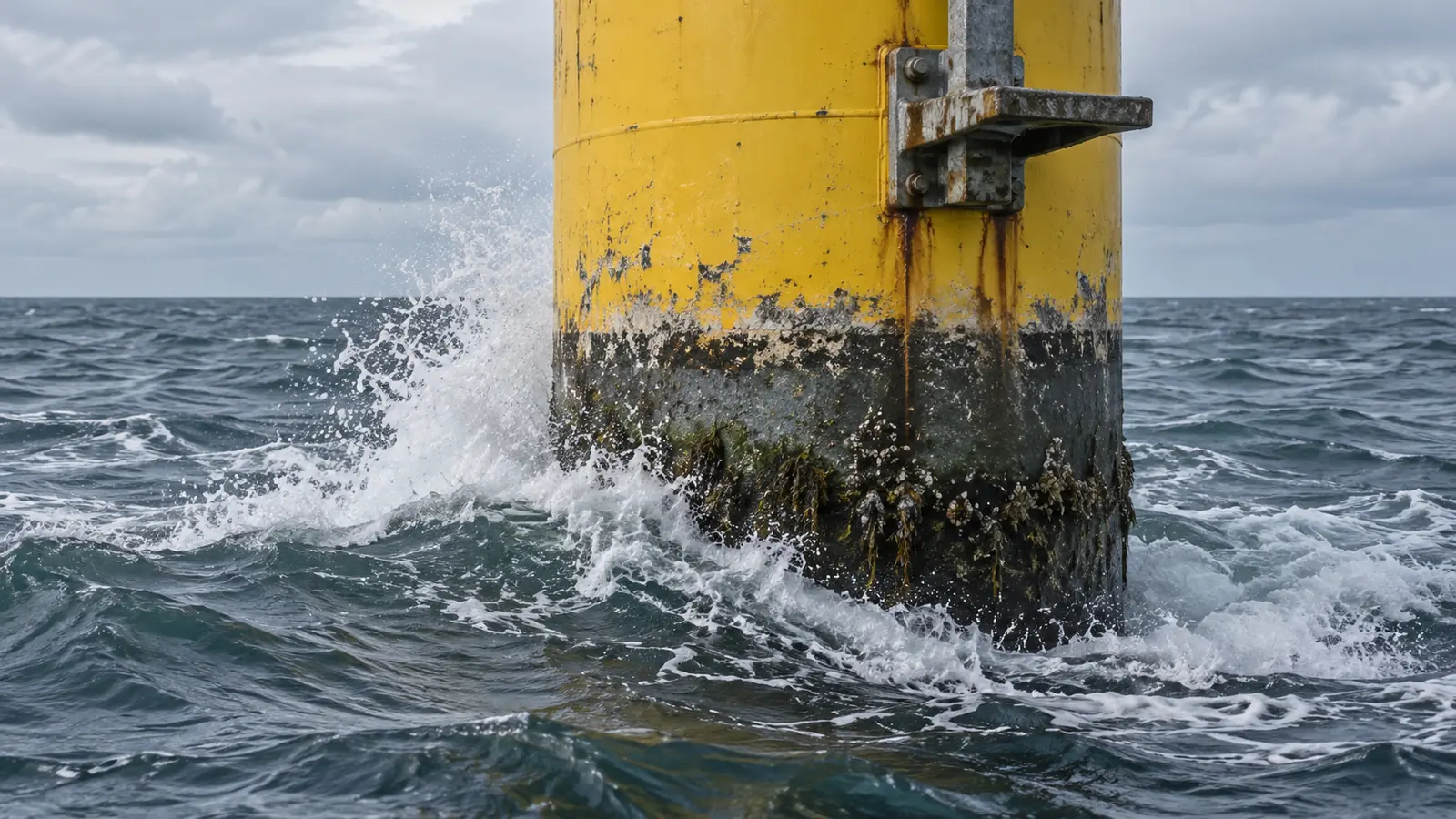
A topside finish kept wet below the waterline can blister and turn a repaint into a removal job. Marine paint for boats splits into topside systems for weathering above water and bottom systems approved for immersion, with barrier protection and fouling control selected as separate functions.
Choose a boat coating system by exposure, substrate and coating history. Above the waterline, the finish handles sunlight, appearance and weather; below it, the system must suit immersion and the boat’s fouling conditions. A primer or epoxy barrier protects the underlying surface, while antifouling or foul-release technology addresses marine growth. The resin name alone does not establish compatibility, film thickness or launch readiness. Start with the hull material, existing finish and time afloat, then verify the exact layer combination in the manufacturer’s current local instructions.
| Input or item | Typical value or source | Why it matters |
|---|---|---|
| Exposure | Above-water weathering or immersion; Interlux layer guide | A weathering finish is not automatically an underwater finish |
| Hull and old coating | Fiberglass/gelcoat, wood or metal; identify the existing system | Adhesion, preparation and primer approval depend on both surfaces |
| Storage and use | Afloat, regularly launched, or trailer-stored with wet contact | Being ashore does not guarantee that the coating dries |
| Barrier film build | Product-specific total dry film thickness (DFT) | Coat count alone cannot prove the barrier is complete |
| Next-layer timing | Exact product pair, substrate temperature and technical sheet | Self-overcoating, antifouling application and launching have separate requirements |
The marine materials section covers the wider corrosion context. The decisions below focus on a boat hull rather than applying offshore structural-steel specifications to every substrate.
What is the difference between topside and bottom paint?
Topside paint supplies the weathering finish above the waterline; a bottom system is selected for immersion and, where needed, resistance to marine growth. Within the bottom system, barrier protection and fouling control do different jobs. The Interlux layer guide shows these functions separately and makes clear that every job does not need every possible layer.
| Coating function | Exposure and purpose | Typical system element | Dominant Failure Mode & Prevention |
|---|---|---|---|
| Topside finish | Above water: appearance and weathering | Compatible undercoat where specified, then a weathering finish | Persistent wetting can blister a topside film; use an immersion-approved system wherever drying cannot be relied on |
| Barrier or protective primer | Protect the substrate; an epoxy barrier can reduce water ingress into prepared laminate | Product-approved primer/barrier, matched to substrate and next layer | Insufficient film build or an undried, damaged laminate defeats the intended barrier; assess the hull and meet the specified total DFT |
| Underwater fouling control | Reduce marine growth on an immersed surface | Approved antifouling or foul-release finish over its specified substrate/system | Wrong service profile or incompatible layer interface can undermine performance; check hull approval, storage/use and the recoat instructions |
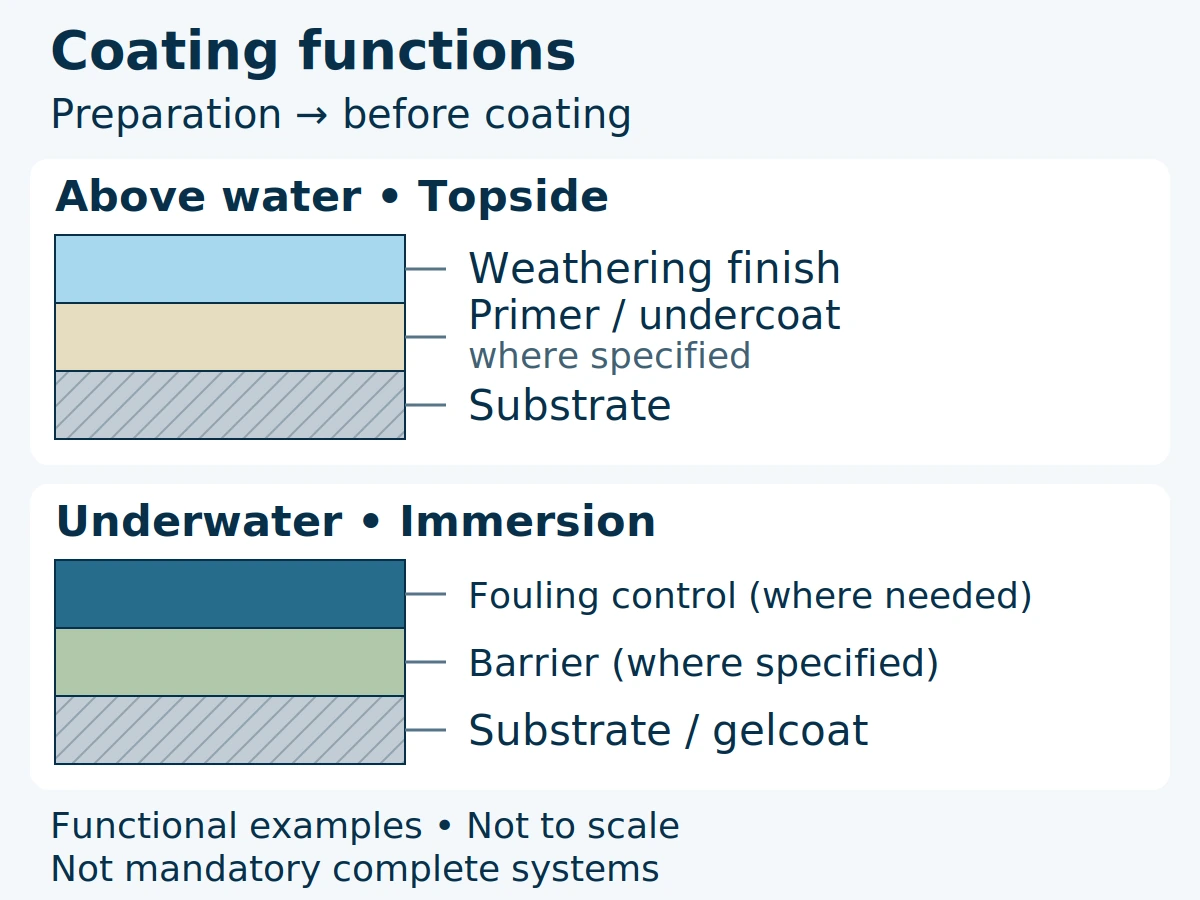
“Waterproof bottom paint” is therefore an incomplete specification. Identify whether the requirement is a water barrier, metal corrosion protection, growth control, or a combination. An epoxy primer does not acquire antifouling properties simply because it is below water, and a product described as modified-epoxy antifouling is not automatically a substitute for a specified barrier primer.
What belongs above the waterline?
Use a compatible weathering finish over the prepared hull and any primer or undercoat required by that system. Traditional one-part alkyd enamels dry through solvent evaporation and/or reaction with air, while two-part aliphatic polyurethanes cure through a reaction after mixing and have a limited working time. These are the distinctions in Interlux’s one-part/two-part guidance; they do not establish that every one-part paint shares the same chemistry or that a two-part finish is immersion-rated.
Where an epoxy layer is exposed to sunlight, check the system’s weathering-topcoat requirement. The Bureau of Reclamation’s April 2012 coatings guide identifies sunlight-induced chalking as a limitation of epoxies. This mechanism explains the role of a compatible outer finish without making epoxy primer mandatory on every boat.
Existing paint can decide the route before finish selection. Interlux’s removal guidance calls for removal of poor finishes and of existing one-part finishes when moving to its two-part system. Identify the old coating and verify the proposed interface; an extra primer coat does not establish compatibility with an unknown base.
What belongs below the waterline?
An immersion-approved system belongs below the waterline; the need for a barrier coat and a fouling-control finish depends on substrate condition and service. On fiberglass, a sound gelcoat surface, a blistered laminate and a previously painted bottom are different starting points. Interlux’s osmosis-treatment guidance puts assessment, preparation and hull drying before the barrier coat. Painting over an undried, blistered hull does not complete that repair.
Rule of thumb — use actual wet exposure as the boundary. If the surface remains immersed or persistently wet, select an approved underwater system. Interlux warns that most topside coatings tend to blister under constant immersion or wetness. Its short-use exception does not establish a universal number of safe immersion days.
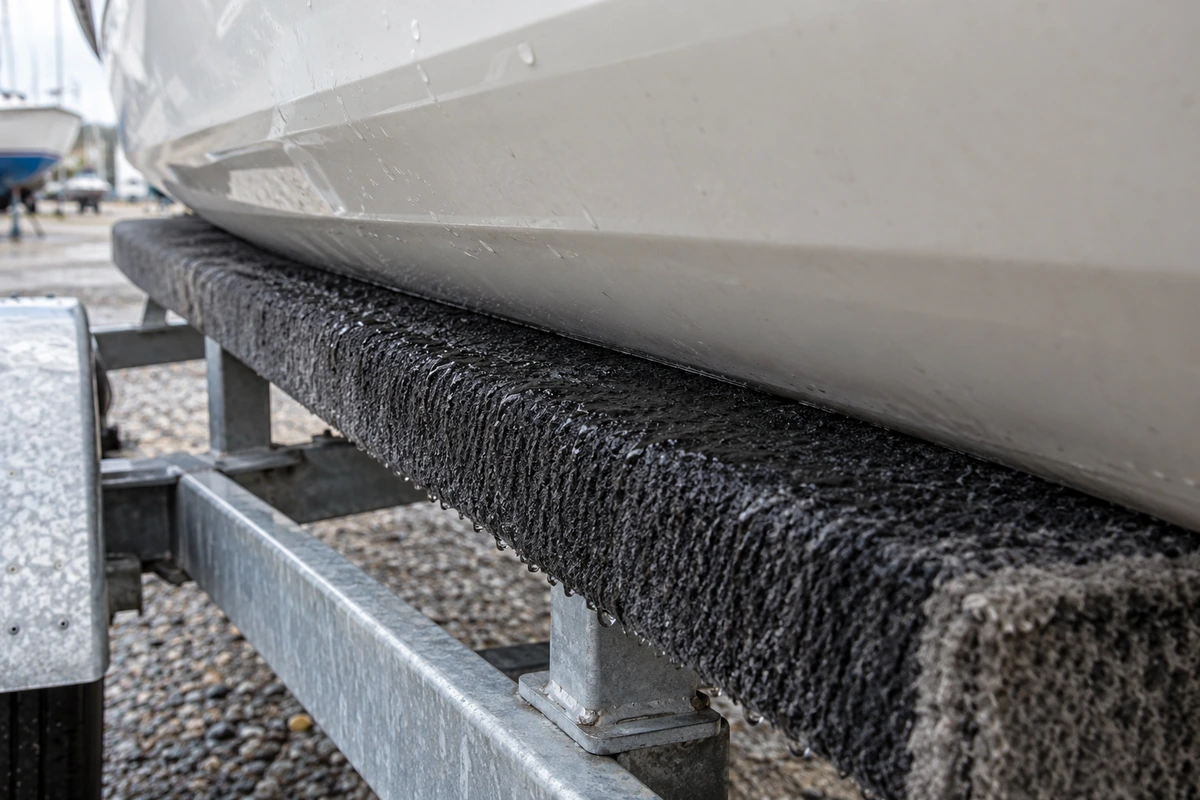
A trailer boat can still have a wet coating at its supports: carpeted bunks can retain moisture against the hull after haul-out. Check that contact condition before treating “stored ashore” as equivalent to “dry.”
For fouling control, distinguish hard antifouling, polishing/ablative systems and biocide-free foul-release technology. The manufacturer’s selection guidance uses hull material, water type, usage, local fouling and storage as inputs. Freshwater alone does not decide the answer, and there is no single renewal interval established for all these technologies. Verify the current local label and maintenance requirements for the selected system.
Aluminum needs an explicitly approved coating-and-primer combination. Interlux’s aluminum guidance describes Trilux 33, containing cuprous thiocyanate, for primed aluminum. That compound contains copper: “approved for aluminum” and “copper-free” are different claims. This example does not authorize an arbitrary copper-containing antifouling on an aluminum hull.
How do film build and recoating change the result?
Total dry film thickness and the time allowed before the next layer are separate acceptance gates. A dated manufacturer example makes the distinction concrete: the InterProtect guide, copyright 2016, specifies 10 mils (0.010 inch) total DFT for InterProtect 2000E on new or non-blistered hulls (printed page 8). Its typical four-to-five-coat count is secondary to that final film build.
Rule of thumb — film-build threshold. In this published InterProtect 2000E example, total DFT below 10 mils has not reached the stated barrier specification, regardless of the number of coats applied. The number is specific to this product and reference procedure. Establish how film build will be checked for the actual substrate: BSI’s catalogue scope for ISO 2808:2019 covers wet- and dry-film thickness measurement methods; it does not supply a universal boat-paint minimum.
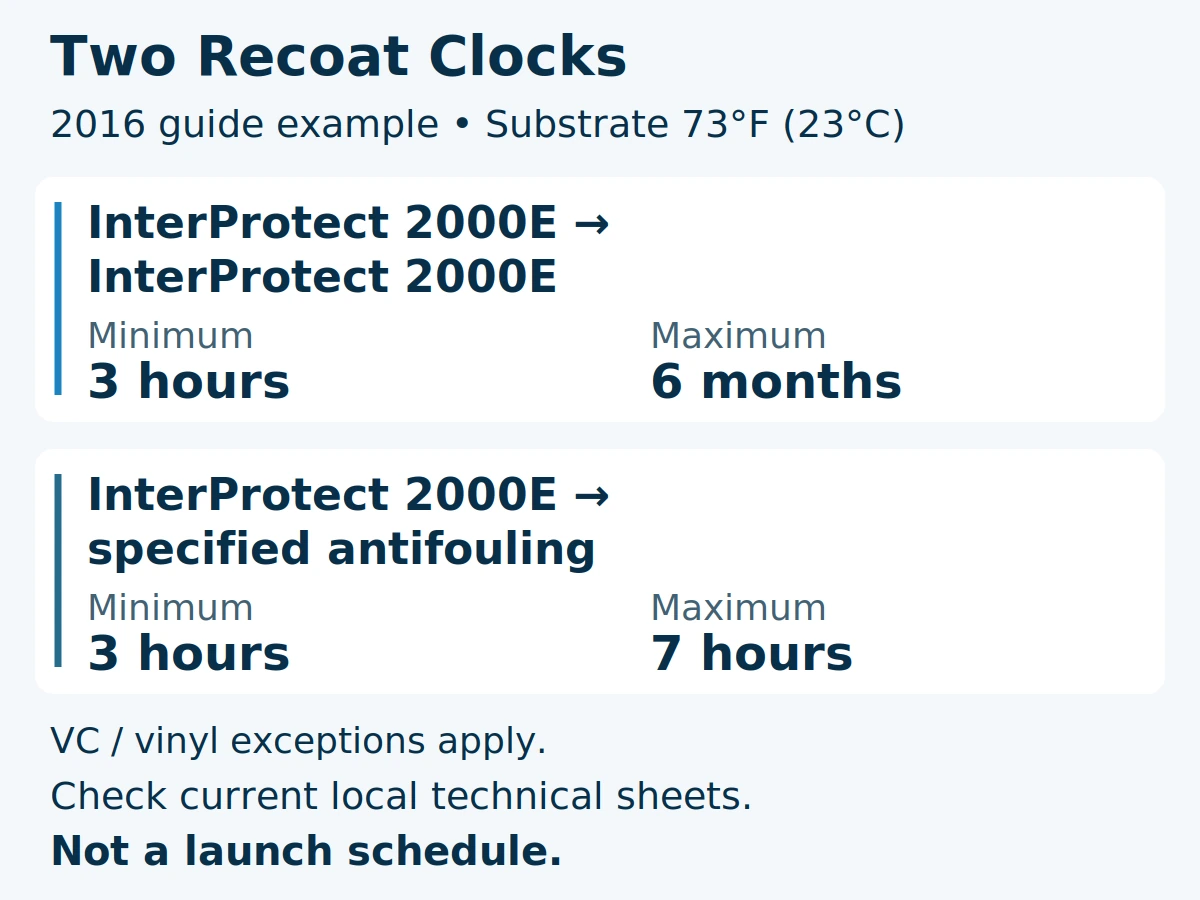
The same 2016 manual gives two distinct overcoating windows at substrate temperature 73°F (23°C):
| Next interface in the guide | Minimum interval | Maximum interval |
|---|---|---|
| InterProtect 2000E to another InterProtect 2000E coat | 3 hours | 6 months |
| Last InterProtect 2000E coat to the specified antifouling interface | 3 hours | 7 hours |
Rule of thumb — interface threshold. At that reference temperature, passing 7 hours is outside the table’s primer-to-antifouling maximum even though it remains within the self-overcoat period. Read the next-product column, then check the current local technical sheets for the exact pair and the response to a missed window.
These are historical reference conditions, not a present application schedule. The guide notes temperature/humidity effects and separate instructions for its listed VC/vinyl antifoulings. Its readiness checks have product exclusions. None of these intervals establishes when a boat may be launched; launch readiness must come from the selected system’s current instructions.
How much coating does the reference system use?
Divide wetted area by the coverage stated for the complete specified system. For the same 2016 InterProtect 2000E example, printed page 6 gives brush/roller coverage of 60 ft² per gallon kit to achieve 10 mils total finished DFT. Its reference hull area is 240 ft².
V_system = A_wetted / C_system
Worked example: 240 ft² ÷ (60 ft² per gallon kit) = 4 gallon kits for the full brush/roller barrier system at the guide’s stated film build.
Do not multiply those four kits by the number of coats: the coverage already represents the complete barrier build. This is also not the antifouling quantity. Measure the real wetted area, use the selected system’s current coverage and separately account for application losses and any other layers; the guide’s hull estimate does not measure an individual boat.
What makes a repaint cost more than the paint?
The project budget must include access, preparation, repairs and rework as well as coating material. The ledger below is an engineering planning framework derived from those system requirements, rather than a price comparison between paint families.
Project cost = coating materials + preparation + access/storage + repairs + rework
| Cost item | Hidden work or loss | Decision before budgeting |
|---|---|---|
| Existing coating | Removal of a poor or incompatible old finish | Identify the base before choosing a replacement system |
| Hull condition | Assessment, repairs and drying before barrier application | Determine whether the job is maintenance or laminate repair |
| Haul-out and storage | Access and waiting while preparation, drying or curing proceeds | Plan around the actual system and available work period |
| Film-build control | Material and inspection needed to reach total DFT | Separate full-system coverage from per-coat coverage |
| Mixed material and missed windows | Unused mixed paint or interface preparation/rework | Size batches to the stated working time; schedule the next layer |
| Fouling management | Cleaning, inspection and later maintenance access | Match the coating technology to storage, use and local fouling |
Make mixed-material loss explicit: V_waste = number of batches × unusable mixed volume per batch.
Assumed planning example: If four batches each leave 0.15 L of unusable mixed coating, 4 × 0.15 L = 0.60 L discarded. This is an assumed batch remainder, not a measured loss rate or a recommended allowance.
Mixed-material loss cost = V_waste × actual mixed-coating cost per litre
For this example, multiply 0.60 L by the actual cost per litre of the combined components at the specified mix ratio. Include that amount once in the coating-material budget; if purchased-material cost already includes the discarded portion, do not add it again. Record any extra interface preparation separately as rework hours × actual labour rate.
For a metal hull or keel, first understand the substrate and barrier functions in the marine paint for metal guide. Where immersed metal and anodes meet the coating system, continue to the marine cathodic protection explainer to understand the electrical-protection interface. Its structural examples are context, not a boat-specific anode-design prescription.
Before selecting paint, establish the hull material, old coating identity, actual wet exposure and the approved sequence of layers. Those inputs make the current technical sheets useful and keep the material estimate tied to the work that will actually be done.
Methods and sources
This explanation uses original manufacturer guidance, the Bureau of Reclamation’s 2012 technical manual and BSI’s public ISO 2808 catalogue scope. The InterProtect quantities, thickness and timing are from a guide marked copyright 2016, accessed October 19, 2026; they are identified reference examples, not evidence of a 2026 product revision. The measurement standard is cited only for its public scope, without claiming access to its full clauses.
Current regional technical sheets remain the authority for the chosen product combination, preparation, film build, recoat and launch requirements. This article establishes no universal immersion duration, moisture acceptance number, service life or repaint saving. For related explanations, return to the Ocean Energy Notes coverage archive.
Updated October 2026.